
List of Positions in a Company From Highest to Lowest
Date Published
List of Positions in a Company From Highest to Lowest
Almost everyone searching for this list wants the same thing: a clean ranking of who sits above whom, from the boardroom down to the intern. You will get that below. But you should know up front that the list is a map of authority, not a map of job size — and those two things separate constantly in real companies. A Director of Engineering running a 40-person function can be worth more points than a VP of Special Projects with two direct reports. If you use the ranking below as your pay structure, you will end up defending decisions you cannot actually defend. So this guide gives you the full hierarchy, explains what each layer genuinely does, shows the spans and scope that separate one layer from the next, and then shows you how to convert the list into levels that hold up.
The short version
- A typical company has eight layers: board, C-suite, executive VP, VP, director, manager, supervisor/lead, and individual contributor.
- Most organizations run five to seven layers between the CEO and the front line. Past eight, decisions slow and accountability blurs.
- Title rank and job size are different measurements. Titles are granted; job size is scored.
- The federal government does not rank titles at all — the BLS classification system groups jobs by what the work is, not by seniority label.
- The fix is to score every role against weighted compensable factors, then let the points set the level and the title follow.
The full list, highest to lowest
Here is the standard corporate hierarchy in order. The point ranges are illustrative, based on a 1,000-point evaluation scale, and are there to show you how much overlap exists between adjacent layers.
Rank | Layer | Typical titles | Typical span | Example point band |
|---|---|---|---|---|
1 | Board of directors | Chair, Lead Independent Director, Board Member | Governance only | Not evaluated |
2 | C-suite | CEO, CFO, COO, CTO, CHRO, CMO, General Counsel | 5–12 direct reports | 800–1,000 |
3 | Executive vice president | EVP, President (division), Group President | 3–8 direct reports | 700–850 |
4 | Senior vice president | SVP, Senior Managing Director | 3–7 direct reports | 620–760 |
5 | Vice president | VP, General Manager, AVP | 3–8 direct reports | 540–680 |
6 | Director | Senior Director, Director, Head of | 3–8 direct reports | 420–580 |
7 | Manager | Senior Manager, Manager | 4–10 direct reports | 320–460 |
8 | Supervisor / team lead | Supervisor, Team Lead, Foreman, Shift Lead | 5–15 direct reports | 240–360 |
9 | Senior individual contributor | Principal, Staff, Senior, Lead (no reports) | None | 300–520 |
10 | Mid-level individual contributor | Analyst II, Specialist, Engineer II | None | 200–320 |
11 | Entry level | Associate, Coordinator, Analyst I, Assistant | None | 120–220 |
12 | Intern / apprentice | Intern, Trainee, Apprentice | None | 80–140 |
Look at rows 9 and 6. A Principal Engineer at 520 points outscores a Director at 420. That is not an error in the table — that is the reality your structure has to accommodate, and it is why the dual career ladder exists.
Example company hierarchies you can download
Three sample grade structures showing how management, professional, technical, and trades ladders sit side by side. Click any chart to enlarge it.
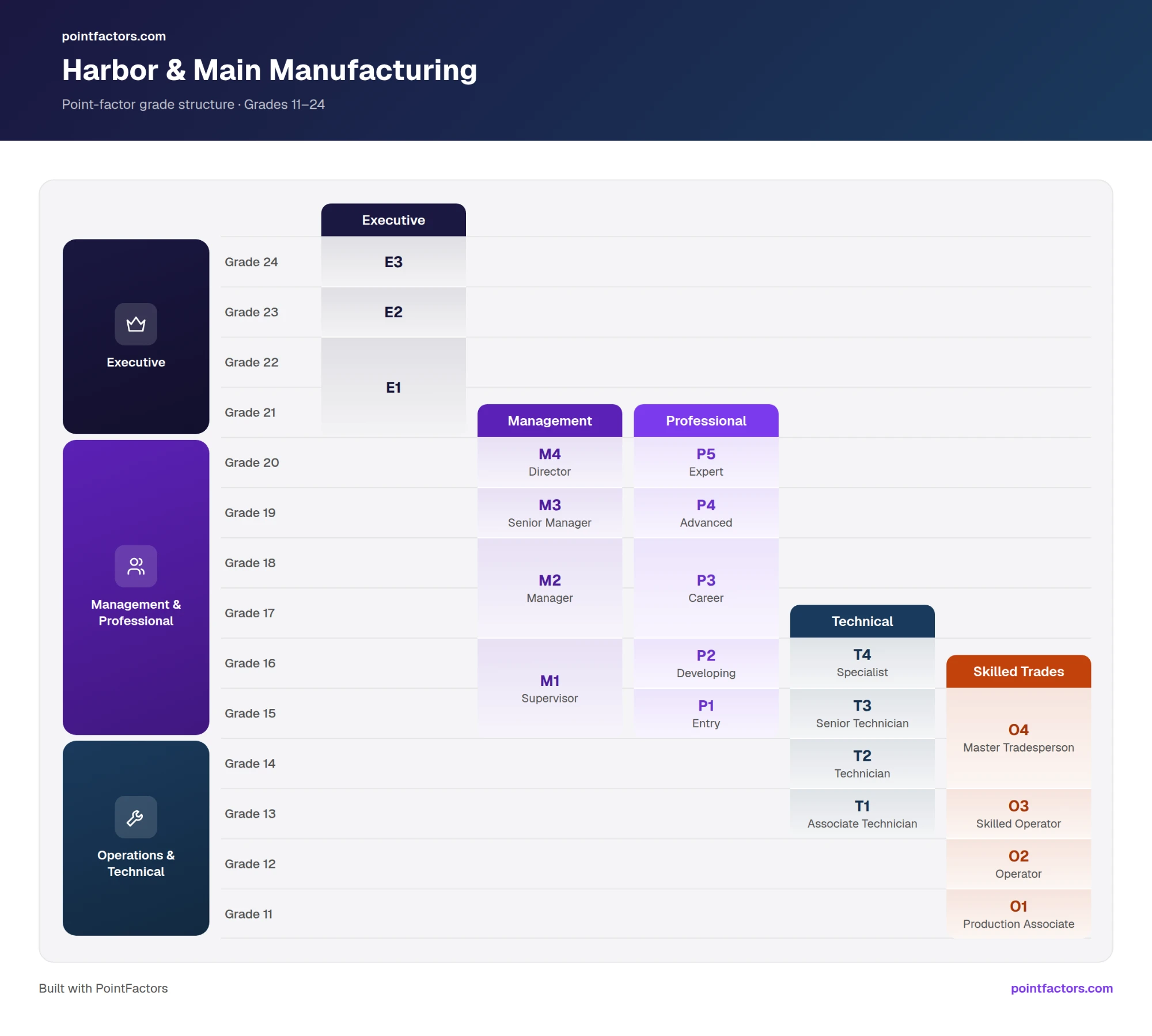
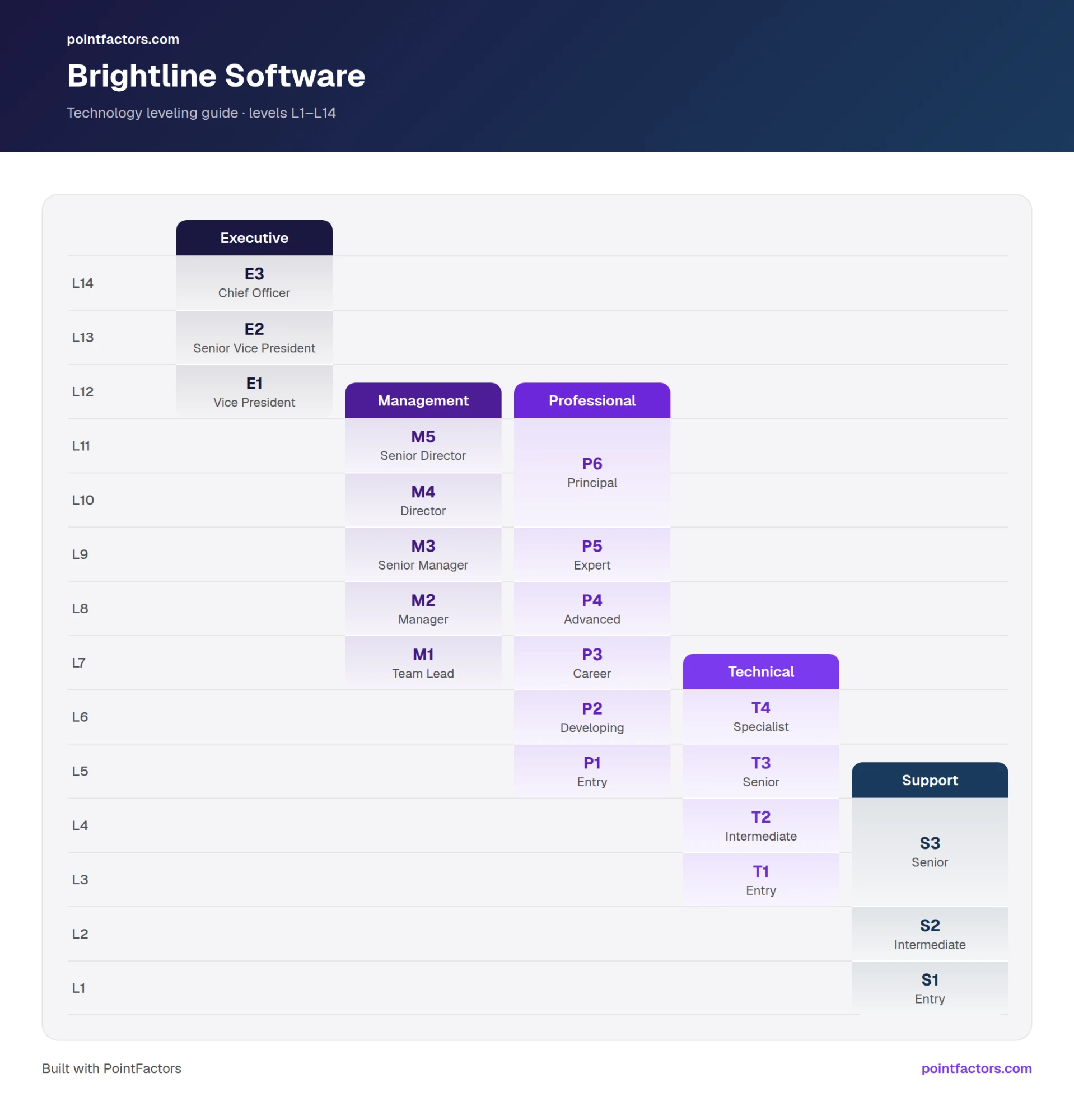
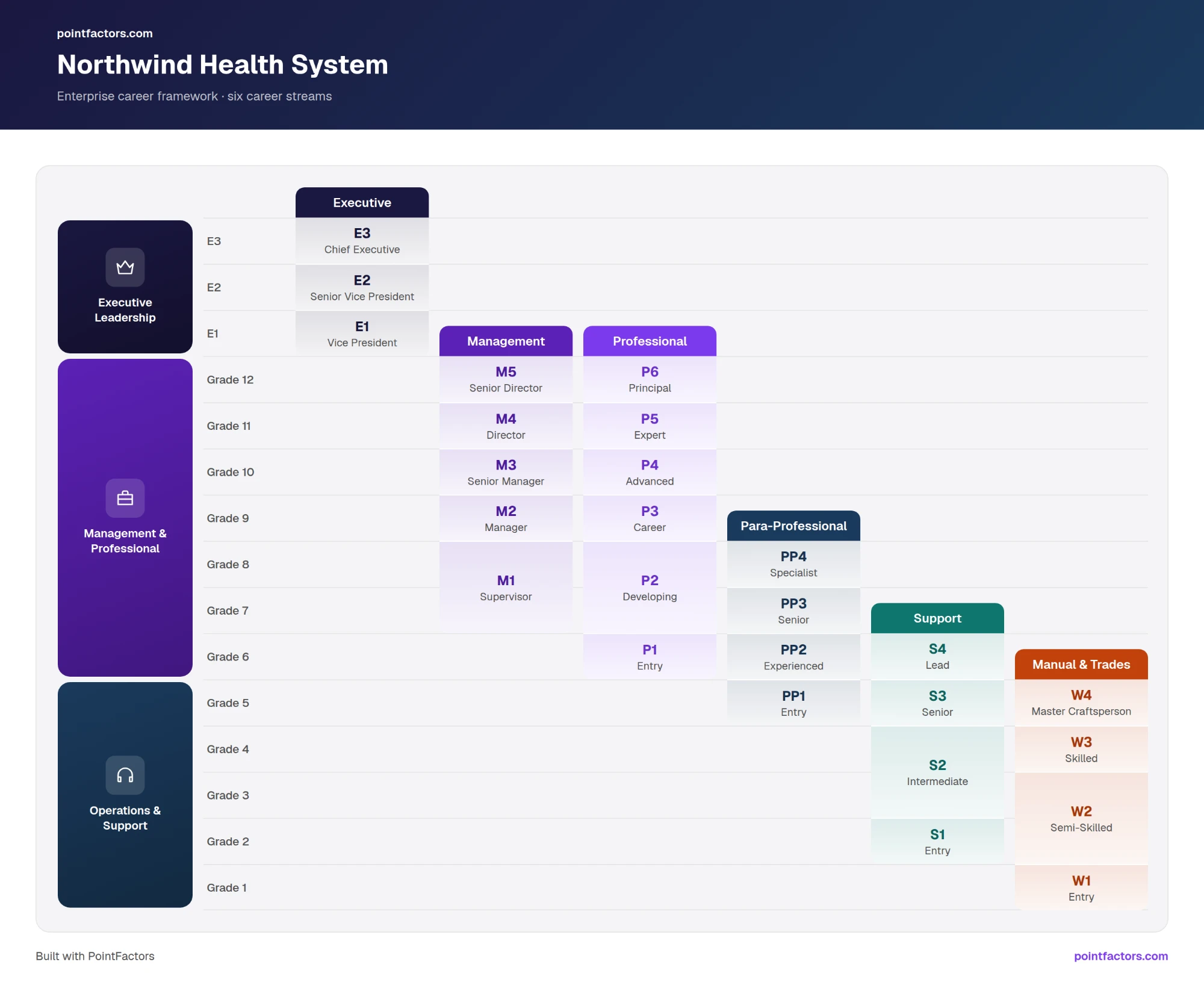
Layer 1: the board of directors
The board sits above everyone, including the CEO, but it is not part of the employee hierarchy. Directors govern; they do not manage. They hire and fire the CEO, approve strategy and budgets, sign off on executive pay, and carry fiduciary duty to shareholders.
Board members are not employees, are not job-evaluated, and are paid through retainers and equity rather than salary. Keep them entirely out of your job architecture. The one exception is an executive chair who also holds an operating role — evaluate the operating role only.
Layer 2: the C-suite
The C-suite owns the enterprise. Each chief officer is accountable for a whole function across the entire company, sets policy rather than executing it, and answers to the board through the CEO.
The Securities and Exchange Commission defines an "executive officer" as the president, any vice president in charge of a principal business unit, division, or function, and any other officer who performs a significant policy-making function (17 CFR 240.3b-7). That definition is worth borrowing even if you are private: the test is policy-making authority, not the letter C in the title.
The pay gap here is real. The Bureau of Labor Statistics put the median annual wage for chief executives at $213,990 in May 2025, against $105,770 for general and operations managers (BLS Occupational Outlook Handbook). That is roughly a 2x step for one layer.
Common C-suite roles, in rough order of how universal they are: CEO, CFO, COO, CTO, CHRO or CPO, CMO, General Counsel, CIO, CRO, CISO, and Chief of Staff. That last one is the trap — a Chief of Staff is usually a Director- or VP-scoped coordination role wearing a C-level word. Score it, do not assume it.
Layer 3–5: the vice president tiers
EVP, SVP, and VP are three distinct layers that most companies collapse into one blurry band. The distinction that actually holds is scope of accountability:
- EVP owns multiple functions or a full P&L business unit. Reports to the CEO. Often carries the title President of a division.
- SVP owns one large function end to end, usually with directors underneath. Reports to an EVP or the CEO.
- VP owns a function or a major sub-function, manages directors or senior managers, and translates strategy into operating plans.
Then there is AVP — Assistant or Associate Vice President. In banking and insurance, AVP is a mid-level professional title that sits below Director. Outside financial services, it usually sits just below VP. If you inherit AVP titles, find out which convention you inherited before you map them. Our executive title classification framework walks through the AVP-to-Chief sequence in detail.
Layer 6: director
Directors are the hinge of the organization. Above them, work is mostly strategy and capital allocation. Below them, work is mostly execution. A director sets the operating plan for a function, owns a budget, manages managers, and is typically the lowest layer with real headcount authority.
Watch for two failure modes. First, the director who manages nobody — common in specialist functions where "Director" was granted as a market-match retention move. Second, "Head of," which reads as director-level at a 200-person company and VP-level at a 2,000-person one. Neither is wrong; both need scoring rather than assuming.
Layer 7: manager
Managers own a team and a process. They hire, coach, run performance conversations, allocate day-to-day work, and are accountable for their team's output rather than for setting direction. This is the first layer where people management is the core of the job instead of an add-on.
Senior Manager is a real distinction when it means managing managers or owning a materially larger budget. It is a fake distinction when it means "good manager we wanted to reward." If you cannot articulate what makes it senior in factor terms — scope, budget, complexity of decisions, number of layers beneath — you have title inflation, not a level.
Not sure whether your titles reflect real level differences? Score two roles you argue about most and see whether the points agree with the org chart. Try PointFactors free.
Layer 8: supervisor and team lead
Supervisors direct daily work but usually do not own hiring, firing, or budget. They assign tasks, check quality, manage schedules and shifts, and escalate. Team Lead is the professional-services equivalent: technical direction plus coordination, often without formal reporting lines.
This layer is huge and frequently mis-scoped. The Bureau of Labor Statistics counted 812,210 first-line supervisors of construction trades and extraction workers alone in May 2025, at an annual mean wage of $86,450 — more than the $69,770 U.S. average across all occupations (BLS Occupational Employment and Wage Statistics, May 2025). Front-line supervision is not a junior job, and pricing it like one is a fast route to turnover.
Layers 9–12: individual contributors
Most of your company lives here, and this is where flat title lists do the most damage. The individual contributor track runs Intern → Entry (Associate, Coordinator, Analyst I) → Mid (Analyst II, Specialist, Engineer II) → Senior → Staff or Lead → Principal → Distinguished or Fellow.
A Principal at a technology company routinely out-earns a Director and sometimes a VP. That is intentional. If your structure forces senior specialists to take a management job to get paid, you will lose your best technical people or promote them into work they are bad at. Build the parallel track deliberately and give the rungs the same point bands as their management counterparts.
Why the ranking is not a pay structure
Here is the part most title lists skip. The federal statistical system — the one that produces all the wage data your salary surveys are built on — does not rank jobs by seniority label at all. The 2018 Standard Occupational Classification organizes every U.S. occupation into 23 major groups, 98 minor groups, and 459 broad occupations, grouped by the nature of the work performed, not by how senior the title sounds (BLS Standard Occupational Classification). "Management Occupations" is a major group because managing is a kind of work — not because managers rank above everyone.
That is the same logic behind job evaluation. The point-factor method scores each job against weighted compensable factors — skill, effort, responsibility, and working conditions, broken into sub-factors like decision-making authority, budget accountability, required knowledge, and span of influence. The total score sets the level. The title is a label you attach afterward, and it can be wrong without breaking anything underneath it.
Two practical consequences:
- Overlap is normal and healthy. Adjacent layers should overlap by roughly 30–50 points in a 1,000-point scale. A tidy structure with no overlap means you are forcing jobs into layers rather than measuring them.
- Layer count matters more than title count. Most well-run organizations operate with five to seven layers between the CEO and the front line. If you are running nine or ten, you likely have layers that exist to hold titles rather than to hold decisions.
How to turn this list into a real structure
Four steps, in order:
- Inventory what you actually have. Pull every unique title with headcount, reporting line, and current pay. Expect surprises — most companies discover 2–4x more unique titles than they have real levels.
- Score a benchmark set. Pick 15–25 jobs spanning every layer and function, then evaluate each one against your factor set. These become your anchors.
- Let the points draw the grades. Cluster the scores, find the natural gaps, and set grade boundaries there. Our guide on converting job evaluation points into pay grades covers the math.
- Map titles onto levels last. Now standardize. Decide that Level 7 is "Director," Level 5 is "Manager," and so on — and then hold the line when a hiring manager asks for an exception. See job leveling and job titles for the naming conventions.
If you want the layer-by-layer view with worked examples, job title hierarchy goes deeper on how the layers relate to each other across functions.
Frequently asked questions
What is the highest position in a company? The board of directors sits above everyone, but the highest employee position is the CEO. The CEO reports to the board, owns enterprise strategy, and is the only role with authority over every function. In owner-operated companies, the founder or owner may hold that position without the CEO title.
Is a director higher than a manager? Yes, in almost every company. Directors typically manage managers, own a function-level budget, and set the operating plan. Managers own a team and execute against that plan. The exception is in film, consulting, and some agencies, where "Director" describes a craft role rather than a management layer.
Is a VP higher than a director? Yes in most industries — VP normally sits one or two layers above Director. The main exception is investment banking and asset management, where the ladder runs Analyst → Associate → VP → Director → Managing Director, so Director sits above VP. Always check your industry convention before mapping.
What comes between manager and director? Usually Senior Manager. Some companies also use Associate Director or Group Manager. Add the rung only if you can define what changes at that level — larger budget, managing managers, broader decision authority — otherwise you are adding a title, not a level.
How many layers should a company have? Five to seven between the CEO and the front line works for most organizations. Fewer than four tends to overload managers with span; more than eight tends to slow decisions and dilute accountability. Regulated, global, or highly specialized businesses can justify more.
Are individual contributors lower than managers? No. Senior individual contributors — Staff, Principal, Distinguished — often score at or above Director and VP level because their decisions carry comparable scope and risk. Rank them by evaluated job size, not by whether they have direct reports.
What is the lowest position in a company? Interns and apprentices sit at the bottom, followed by entry-level roles titled Assistant, Coordinator, Associate, or Analyst I. These jobs are defined by close supervision, narrow decision authority, and limited required experience.
Does the title order affect pay compliance? It can. Pay transparency and equal-pay laws generally compare substantially similar work, not matching titles. Two people with different titles doing comparable work are still comparators. A documented, points-based level structure is far easier to defend than a title ranking.
Stop ranking titles. Start measuring jobs.
The hierarchy above is a useful shared vocabulary. It is a terrible pay structure. Every organization that tries to run compensation off title rank ends up with inflated titles, indefensible ranges, and no answer when an employee asks why the person one desk over earns more for the same work.
PointFactors scores your jobs against weighted compensable factors and produces the level structure the title list only pretends to give you — with the documentation to back up every placement. Start a free evaluation or see pricing.
Justin Hampton is founder and CEO of PointFactors.
Join the PointFactors newsletter
One email a month on job evaluation, pay equity and pay transparency. No spam; unsubscribe anytime.